
Auxilus Mos · Emergency and operations

PBB Hotline / Vox

Local emergency intake, incident handling, command reporting, and support coordination for barangay and command nodes.

Integrated · Pilot-ready foundation Baseline node service
Primary placement
Barangay node; Local command node
Primary users
Citizens, Barangay emergency operators, Command staff, Local administrators

What it is

A practical part of one local platform

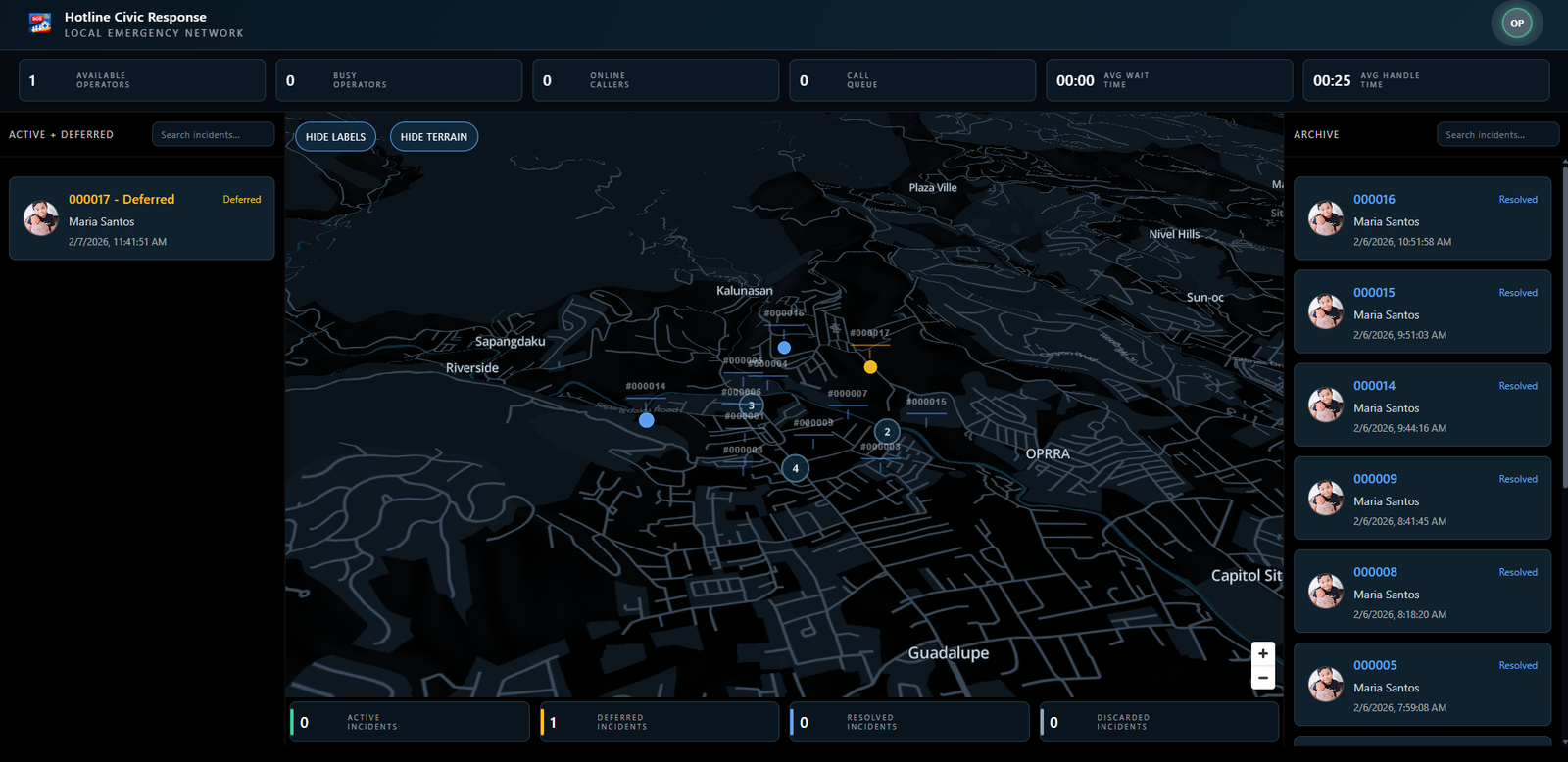
PBB Hotline / Vox is the local emergency operations surface for citizens, operators, command users, and administrators. It supports emergency intake, incident work, team assignment, command alerts, SITREP preparation, and support requests from a PBB node.

The module uses local node services for live communication and maps. Its confirmed upstream paths are selective: completed SITREP and support-request workflows can be handed to Relay, while editable incident records are not broadly replicated between nodes.

Problem it solves

The operational gap

During an emergency, reports can arrive through fragmented calls and messages while operators lack a shared local view. Vox provides one node-local workflow for intake, incident handling, command reporting, and requests for outside support.

Core workflow

How Vox supports local work

  1. Report locally

    A citizen reaches the local Hotline surface and starts an emergency report while connected to the node network.

  2. Triage and coordinate

    Operators review incident details, location, resources, team assignments, messages, and media in the local workbench.

  3. Build command context

    Command staff issue alerts and prepare structured situation reports from local operational information.

  4. Send selected updates

    SITREPs and support requests can enter Relay-backed delivery and retry workflows when the route upstream is available.

Who uses it

Designed around local service roles

  • Citizens
  • Barangay emergency operators
  • Command staff
  • Local administrators

Screenshots and prototypes

Validated product evidence

Offline-first behavior

What continues locally—and what does not

Works on the local node

  • Citizen intake, operator incident work, command reporting, messages, and local media storage can continue over the node LAN while the app and database are available.
  • SITREP and support-request delivery records can persist locally for server-side retry.

Required local services

  • PBB Realtime is required for supported live presence, call, message, and media events.
  • PBB MapServer must be prepared and available for offline tiles and boundaries.

When a route returns

  • The latest SITREP can be handed to PBB Relay through a persisted delivery path.
  • Support requests and their confirmed lifecycle updates can move through Relay and PBB Support System.

Connectivity-dependent

  • Delivery to an upstream or peer node waits for a reachable Relay route.
  • Map cache misses may require an upstream tile provider if the requested area was not prepared.

Not currently synchronized

  • No durable browser-side citizen report outbox is confirmed.
  • Editable incident records are not broadly synchronized between nodes.

Deployment placement

Where it fits

Baseline deployment

Barangay node; Local command node

Hardware, connectivity, power, training, travel, and field logistics remain deployment-specific.

Practical questions

Frequently asked questions

Can Hotline keep working when the internet is down?

Yes, local work can continue while Hotline and its supporting services are running on the local PBB network. Messages meant for another node will wait until a connection becomes available.

Can a citizen submit a report after leaving the local network?

Not reliably. The current design does not confirm that a browser can save a report while disconnected and send it later. Hotline's offline support applies within the local PBB network.

Are live incident records copied to every PBB node?

No. Full editable incident records are not copied everywhere. Nodes send only selected situation reports and support-request updates through Relay.

What does PBB Realtime provide to Vox?

PBB Realtime supports live updates for who is connected, calls, messages, media, and other app activity. One shared Realtime service is expected to run on each node.

Will maps always be available offline?

No. Only map areas and boundaries prepared in advance will work reliably offline. Looking outside those prepared areas may require internet access.

How does Vox ask another operations team for support?

Vox saves the request locally, then Relay can send the approved request details to a designated PBB Support node. That node can return updates as the request is handled.

Status and readiness

Integrated

Core citizen, operator, command, SITREP, support-request, Realtime, and MapServer workflows are implemented and integrated.

Remaining hardening work

  • Define production retention and media-handling policy.
  • Complete deployment runbooks and security hardening.
  • Document browser behavior during complete local network loss.

Connected platform

Local-node foundation

Briefing and pilot discussion

Discuss Vox in a local PBB deployment

Explore how a local-node deployment could support practical service continuity in your community.

Request a briefing